
How Many Stanchions Do I Need? A Practical Guide
Stanchions Toronto · 6 min read
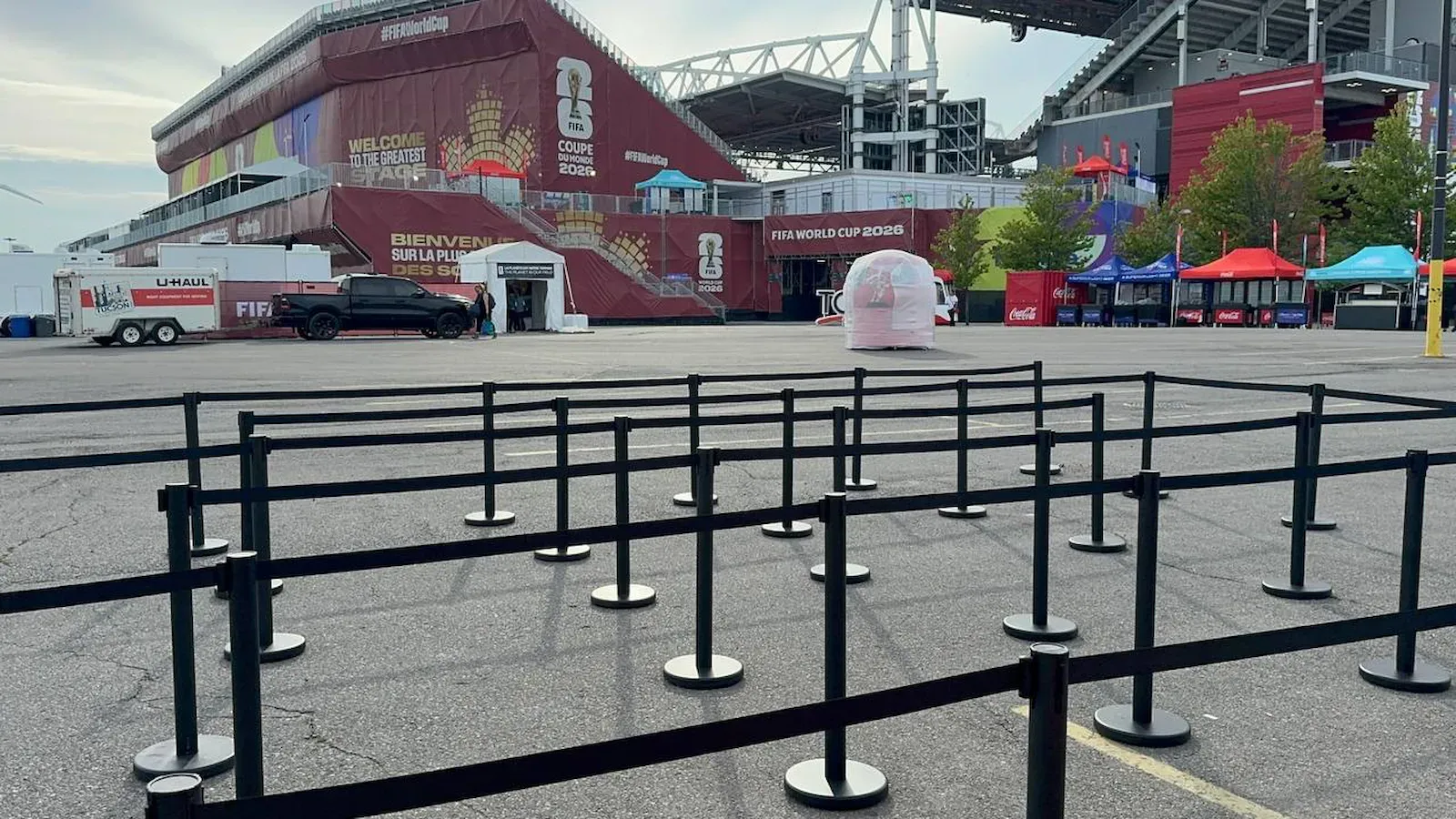
Almost every quote request we get starts with a length and a guess. Someone knows the queue is "about forty feet" or the carpet is "roughly twenty-five", and they are not sure whether that means eight posts or fifteen. The arithmetic is simple once you have seen it, and it is the same three steps whether you are shaping a registration line, framing an arrivals carpet or closing a perimeter.
This guide covers all three, with the two rules that do most of the work and the one mistake that catches nearly everyone the first time.
The two rules
1. Spacing: about 4 ft between rope posts
A velvet rope is 5 ft long, but you do not set the posts 5 ft apart. Posts go about 4 ft apart so the rope hangs in a curve instead of being pulled straight — and that curve is the entire point of a rope line. Set them at the full 5 ft and you get a taut line that looks like a barrier; set them at 4 ft and you get the drape people associate with an arrival.
So 4 ft is the number you plan and count with, not 5.
Belt stanchions work differently: the belt is 8 ft and it retracts, so you can place posts anywhere up to that limit. In practice most people run them somewhere between 6 and 8 ft apart, tighter through a busy switchback where people lean on the belt.
2. The off-by-one: posts always outnumber ropes by one
A post stands at each end of every span. So a straight run of n posts gives you n − 1 spans, which means n − 1 ropes and (n − 1) × 4 ft of line.
Turn it around and you get the formula you actually need:
Ropes = length ÷ 4, rounded up. Posts = ropes + 1.
This is where most first-time orders go wrong. Counting one post per rope feels right and leaves you a post short, with the last stretch of the run unroped — the awkward gap you cannot fix once the guests are arriving.
Worked example 1: a registration queue
Say you have a conference registration area and you want a single lane about 40 ft long feeding four check-in desks.
With belt stanchions, at 8 ft between posts: 40 ÷ 8 = 5 spans, so 6 posts. That is the minimum for a straight lane. In practice you would add:
- a post at every corner if the lane turns;
- a post either side of each desk head, so the front of the line is defined;
- one or two spares, because the layout always changes once the room is dressed.
Turn that lane into a switchback and the count goes up sharply, because every turn is a post. A three-lane switchback in the same floor area typically needs closer to 14–16 posts than 6. If you have a floor plan, send it — the count comes off the drawing far more reliably than off a length.
How much floor does a queue need?
A useful sanity check: people in a moving queue occupy roughly a metre each front to back. A 40 ft (12 m) lane holds somewhere around a dozen people comfortably. If you are expecting 200 people through the doors in the first fifteen minutes, one 40 ft lane is not the answer — more desks and more lanes are.
Worked example 2: a red carpet arrival
Now the classic: a 25 ft carpet, framed with rope stanchions on both sides.
Apply the rule. 25 ÷ 4 = 6.25, round up to 6 spans, so 6 ropes and 7 posts — per side. Six spans at about 4 ft is 24 ft of rope line against a 25 ft runner, and the last foot disappears into the drape.
Both sides, then: 14 posts and 12 ropes.
Scale it and nothing changes but the numbers. A 40 ft carpet is 10 ropes and 11 posts per side. A 60 ft carpet is 15 ropes and 16 posts per side. Only the count moves — the rule behind it does not. And if you would rather not count at all, the red carpet package puts the runner and the rope stanchions on a single order, and the counts get worked out when we quote it.
Worked example 3: an outdoor perimeter
Perimeters are a different product and a different unit. Barriers come in sections of 6.9 ft, so you divide by seven rather than four:
- a 40 ft stage front is 6 sections;
- a 120 ft run across the back of a site is 18 sections.
Two things change the count more than the length does.
Gates. Every opening splits one run into two, and each run rounds up on its own. Take that 120 ft perimeter and leave a 10 ft gap 40 ft along it for crew vehicles: you now have a 40 ft run and a 70 ft run — 6 sections plus 11 — which is 17, not the 16 you would get by subtracting the gap from the total. Budget about one extra section per opening.
What is already there. Measure the line you actually need to hold, not the footprint. A wall, a hedge, a building or a fence is doing part of the job for free.
Quick reference
- Rope stanchions: ropes = length ÷ 4 (round up); posts = ropes + 1.
- Belt stanchions: posts = length ÷ 8 (round up) + 1, plus one per corner.
- Barriers: sections = length ÷ 6.9 (round up), plus about one per gate.
- Double it for anything framed on both sides, like a carpet.
- Add spares if the layout is still moving — one or two saves the evening.
When the arithmetic is not the answer
Two situations where the formula gives a number you should ignore.
Crowds under pressure. Stanchions guide people who are willing to be guided. If the crowd is outdoors, standing, or pushing forward at doors-open, no quantity of posts will hold it — that is a barrier job. Get the perimeter right first, then use stanchions inside it for the routes that need shaping.
Rooms that change. If the layout is genuinely unsettled — a venue you have not walked, a plan still being argued over — order to the longest sensible version and expect to place fewer. It is a much smaller problem than being three posts short at 6 pm.
Send us the length
If you would rather not do the arithmetic: send the walked length, the shape and the event address, and we will put the count on your quote. Runners are cut to length, so the carpet number is whatever your walk measures — see carpet runners — and the posts follow from it.